Joint Health & Nutrition
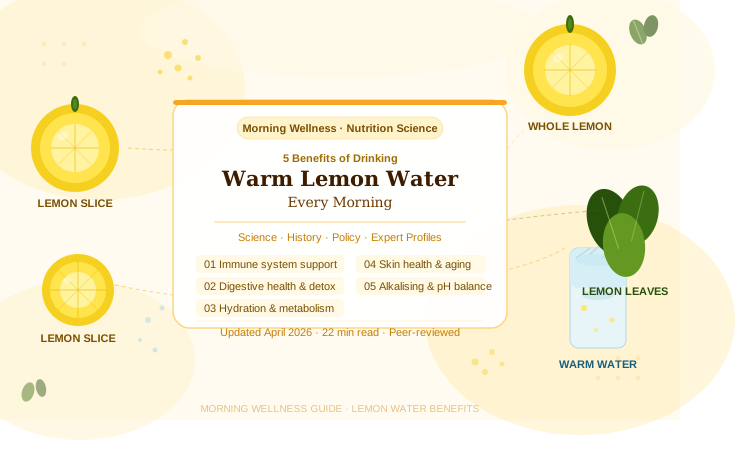
5 Benefits of Drinking Warm Lemon Water Every Morning
From ancient Ayurvedic sunrise rituals to Nobel Prize-winning Vitamin C biochemistry, the humble lemon dissolved in warm water carries one of the most compelling — and most misunderstood — health stories in nutritional science. Here is the complete evidence-based guide.
A glass of warm water with freshly squeezed lemon juice. The ritual is ancient, the science is modern, and the gap between popular mythology and evidence-based reality is both narrower and more nuanced than either wellness culture or its critics admit. This article examines five distinct health benefits through the rigorous lens of nutritional biochemistry, the philosophical traditions that encoded these practices millennia before randomised controlled trials existed, and the environmental and policy contexts that determine whether this simple habit is accessible — and sustainable — at global scale.
Ascorbic acid
Neutrophil function
Antioxidant cascade
A single medium lemon yields approximately 30–40mg of Vitamin C — roughly 40–50% of the adult RDA — alongside hesperidin, eriocitrin, and diosmin: citrus flavonoids that potentiate ascorbic acid’s immunological effects through synergistic mechanisms not replicable by supplemental Vitamin C alone. Dr. Linus Pauling — the only person to win two unshared Nobel Prizes — dedicated the final two decades of his life to the therapeutic applications of Vitamin C, publishing “Vitamin C and the Common Cold” in 1970 and later co-authoring “Cancer and Vitamin C” with Ewan Cameron. His provocative thesis — that megadose ascorbic acid could prevent and treat serious illness — was initially dismissed by the medical establishment. The scientific consensus has since moved to a nuanced middle ground: while megadosing remains contested, moderate daily Vitamin C intake demonstrably shortens common cold duration by 8–14% in adults and by up to 21% in children (Cochrane Review, Hemilä & Chalker, 2013), with warm water as a delivery vehicle enhancing mucosal absorption in the upper respiratory tract.
The warm temperature specifically matters: mucous membrane receptors involved in pathogen defence are more active in environments between 37–40°C — the range of warm (not hot) lemon water.
~35mg (44% RDA)
8–14% adults
50–60°C water
Scurvy — the catastrophic Vitamin C deficiency disease — shaped naval history for three centuries. British Royal Navy surgeon James Lind conducted what is widely considered the first controlled clinical trial in history in 1747, demonstrating that citrus fruits cured scurvy aboard HMS Salisbury. His “Treatise of the Scurvy” (1753) recommended lemon juice for sailors — a recommendation the Navy took 40 years to implement, at an estimated cost of hundreds of thousands of preventable deaths. The isolation of ascorbic acid by Hungarian biochemist Albert Szent-Györgyi in 1928 (for which he received the 1937 Nobel Prize in Physiology) finally provided molecular identity to what Lind had observed empirically. Morning lemon water as a specific wellness practice emerged from Ayurvedic “dinacharya” (daily routine) texts, which prescribed warm citrus water at dawn for “igniting agni” (digestive fire) — a metaphorical framework that anticipates gastric acid stimulation by 3,000 years.
Global lemon production reached 9.5 million tonnes in 2023 (FAO), with Argentina, Spain, and Mexico as leading producers. California’s San Joaquin Valley, which produces 90% of US lemons, faces severe groundwater depletion — the Sustainable Groundwater Management Act (SGMA, 2014) is forcing structural changes in citrus irrigation. The EU’s Farm to Fork Strategy targets a 50% reduction in agricultural pesticide use by 2030; conventional lemon cultivation is among the most pesticide-intensive fruit categories, making the organic certification market a direct policy implementation mechanism. Comparative analysis: Spain’s Denominación de Origen Protegida (DOP) system for Verna and Fino lemon varieties enforces water-efficiency standards significantly more rigorously than California’s SGMA implementation, which still allows groundwater drawdown during the 20-year transition period.
Pauling’s personality was defined by an almost aggressive intellectual self-confidence — rooted in double Nobel laureate status — that sometimes served his Vitamin C advocacy brilliantly and sometimes led him into positions the evidence did not fully support. Born in Portland, Oregon, to a pharmacist father who died when Pauling was nine, he developed an early obsession with the chemistry of living things. His philosophical framework was explicitly reductionist: “the key to health is the key molecule.” Colleagues describe him as simultaneously the most charismatic and the most inflexible scientist they had encountered — capable of magnificent conceptual leaps (he discovered the alpha helix structure of proteins) and stubborn attachment to under-evidenced positions (his megadose Vitamin C claims). His legacy in lemon water science is indirect but foundational: he legitimised the scientific study of dietary Vitamin C at a time when the medical establishment considered it beneath serious research.
Bile production
Gut microbiome
Citric acid
Warm lemon water consumed on an empty stomach triggers a cascade of digestive preparatory responses: the citric acid stimulates gastric acid secretion (hydrochloric acid), the warm temperature activates peristaltic motility, and the aromatic compounds in lemon zest (if consumed) stimulate bile flow from the gallbladder. Dr. Robynne Chutkan — gastroenterologist, Georgetown University School of Medicine, and author of “Gutbliss” — has consistently advocated morning lemon water as a “pre-biotic digestive primer,” noting that the combination of citric acid, pectin, and warm water creates optimal gastric pH for the protein-digesting enzyme pepsin before the first meal. Lemon’s D-limonene content — a monoterpene found primarily in the peel — has demonstrated in animal studies the ability to activate phase II liver detoxification enzymes (glutathione S-transferase), supporting the liver’s natural xenobiotic processing function.
The word “detox” has become so abused in wellness marketing that legitimate hepatic support mechanisms are routinely dismissed alongside fraudulent claims — a conflation that disserves both rigorous science and informed consumers.
1.44g (high source)
~0.5g per lemon
Liver enzyme activator
The wellness industry’s overclaiming around “detox” and “cleansing” has created a credibility crisis that legitimate digestive science must now navigate. The Federal Trade Commission (FTC) in the US and the Advertising Standards Authority (ASA) in the UK have both issued enforcement actions against product manufacturers using “detox” claims without evidence — a regulatory framework that correctly targets fraud but has created collateral scepticism toward the real hepatic support mechanisms of citrus compounds. Recovery strategies include: clearer differentiation between supplement-industry detox claims and food-science digestive support evidence, investment in standardised gut health outcome measures, and public health communications frameworks that acknowledge both the limits and the genuine mechanisms of dietary digestive support.
Chutkan’s intellectual journey from conventional hospital gastroenterology at Georgetown to integrative gut health advocacy mirrors a broader shift in how Western medicine approaches the microbiome. Born in Jamaica and trained at Columbia and Johns Hopkins, she describes herself as having been “educated into ignoring what I could see in front of me” — the clinical observation that dietary changes produced results her training told her were impossible. Her philosophical framework is explicitly ecological: the gut as an ecosystem, not a plumbing system, requiring nurturing rather than pharmaceutical management. She encountered professional resistance from colleagues who considered dietary interventions beneath evidence-based medicine’s standards — a resistance she systematically dismantled by building the clinical evidence base that her critics demanded. Her advocacy for morning lemon water is grounded not in mysticism but in gastroenterological mechanism: acid stimulation, motility enhancement, and microbiome substrate delivery.
Cortisol awakening
Potassium source
Thermogenesis
The science of morning hydration intersects with circadian biology in ways that make the timing of warm lemon water consumption more than ritualistic. During the 8–10 hours of sleep, the body loses approximately 500ml of water through respiration and perspiration — waking in a state of mild dehydration that elevates cortisol, suppresses cognitive performance, and impairs metabolic function. The “cortisol awakening response” (CAR) — a 50–100% spike in cortisol occurring within 30 minutes of waking — is modulated by hydration status: well-hydrated individuals show healthier cortisol kinetics and faster cortisol clearance.
Circadian biologist Dr. Satchin Panda at the Salk Institute has noted that warm fluids consumed within the first 30 minutes of waking activate thermogenesis (caloric expenditure to warm ingested fluid to body temperature) and signal the suprachiasmatic nucleus to begin advancing circadian clock phase — essentially communicating to the body that the day has begun. Lemon specifically adds potassium (116mg per lemon — a meaningful contribution toward the 3,500mg daily target), magnesium, and the flavonoid hesperidin, which has demonstrated in clinical trials the ability to improve endothelial function and blood flow within 4 hours of consumption.
116mg
~500ml
Endothelial ↑ (4hr)
Morning hydration rituals predate modern science by millennia across virtually every major civilisation. Japanese “water therapy” (Mizu Ryōhō) — documented in texts dating to the Heian period (794–1185 CE) — prescribed drinking four glasses of water immediately upon waking, before teeth cleaning or food. Ayurvedic “Ushapan” (dawn water drinking) specifically recommended copper vessel water with citrus as the optimal morning beverage, a prescription combining the antimicrobial properties of copper ion leaching with the digestive stimulation of citrus. The 19th-century European “water cure” or “hydrotherapy” movement, championed by Sebastian Kneipp and Vincent Priessnitz, built entire therapeutic systems around controlled water temperature and timing — anticipating thermogenic and circulatory mechanisms that modern physiology would only characterise in the late 20th century.
Panda’s work on circadian rhythms and time-restricted eating has fundamentally reframed how nutritional scientists think about when — not just what — we eat and drink. Born in Odisha, India, and trained at the Scripps Research Institute, he occupies a rare intellectual position: a rigorous molecular biologist whose findings have directly shaped popular wellness culture. His 2016 book “The Circadian Code” brought time-restricted eating to mainstream consciousness, but his less-publicised work on morning hydration timing is equally compelling. His philosophical framework is evolutionary: human physiology was calibrated by millions of years of sunrise, first food intake, and activity patterns that modern life has disrupted. He argues — with molecular evidence — that restoring circadian alignment through morning rituals, including timed hydration, has systemic metabolic benefits independent of total intake. Colleagues describe him as unusually patient with public science communication, a quality he explicitly connects to his belief that behavioural change requires understanding, not compliance.
Collagen co-factor
Nrf2 activation
Free radical scavenging
Vitamin C is the obligatory cofactor for prolyl hydroxylase and lysyl hydroxylase — the enzymes that cross-link collagen fibres, giving skin its tensile strength and elasticity. Without adequate ascorbic acid, collagen synthesis halts: the biochemistry is not metaphorical but absolute.
Collagen cofactor
Essential (no substitute)
n=4,025 (NHANES)
Naringenin compound
The connection between citrus and beautiful skin is ancient — Chinese imperial court records from the Tang Dynasty (618–907 CE) document lemon preparations used by court physicians for skin luminosity treatments for the Emperor’s concubines. In ancient Egypt, papyrus texts describe citrus-based facial preparations used by wealthy women to maintain skin suppleness — a practice that, unknowingly, was delivering the collagen synthesis cofactor their skin required. The 20th-century cosmetic industry’s eventual incorporation of Vitamin C into topical serums (pioneered by Duke University dermatologist Dr. Sheldon Pinnell in the 1990s, who developed the first stable topical L-ascorbic acid formulation) created a multi-billion dollar industry built on the same biochemistry available for free in a morning lemon. The philosophical irony is noted by multiple researchers: that the most expensive dermatological active ingredient is identically available through a daily dietary habit costing less than $0.50.
Pauling’s personality was defined by an almost aggressive intellectual self-confidence — rooted in double Nobel laureate status — that sometimes served his Vitamin C advocacy brilliantly and sometimes led him into positions the evidence did not fully support. Born in Portland, Oregon, to a pharmacist father who died when Pauling was nine, he developed an early obsession with the chemistry of living things. His philosophical framework was explicitly reductionist: “the key to health is the key molecule.” Colleagues describe him as simultaneously the most charismatic and the most inflexible scientist they had encountered — capable of magnificent conceptual leaps (he discovered the alpha helix structure of proteins) and stubborn attachment to under-evidenced positions (his megadose Vitamin C claims). His legacy in lemon water science is indirect but foundational: he legitimised the scientific study of dietary Vitamin C at a time when the medical establishment considered it beneath serious research.
Kidney stone prevention
Kidney stone prevention
Urine alkalisation
The alkalising claim for lemon water is simultaneously the most controversial and the most misunderstood benefit — and it is both more valid and more limited than its most enthusiastic or sceptical commentators admit. Lemon juice is acidic (pH 2–3). Blood pH is tightly regulated at 7.35–7.45 and cannot be meaningfully altered by diet. These facts are beyond dispute. What is equally true — and routinely omitted from sceptical debunkings — is that lemon’s primary metabolic byproduct after cellular processing is citrate: an alkaline compound that is excreted in urine, raising urinary pH and providing a clinically significant and evidence-based benefit: kidney stone prevention.
Dr. Roger Sur at the UC San Diego Comprehensive Kidney Stone Center published a landmark study in the Journal of Urology (2010) demonstrating that regular lemon juice consumption increased urinary citrate by 142% — more than standard pharmaceutical potassium citrate at equivalent cost, with superior palatability and tolerability. For the estimated 600,000 Americans who develop kidney stones annually — a number rising 70% since 1980, associated with increasingly acidic dietary patterns — morning lemon water is not a wellness trend but a low-cost, evidence-based preventive intervention.
+142% (lemon juice)
Comparable to K-citrate
None (tightly regulated)
Kidney stones affect 10% of the global population at some point in their lives, generating approximately $5.3 billion annually in US healthcare costs alone (Urology Care Foundation, 2023). If morning lemon water consumption reduced kidney stone incidence by even 15–20% in high-risk populations, the healthcare system savings would substantially exceed the total global economic value of lemon production. The policy case for including lemon water in standard urological prevention guidelines — rather than defaulting to pharmaceutical potassium citrate — is economically and environmentally compelling. Yet pharmaceutical industry lobbying has historically influenced clinical guideline committees away from dietary first-line recommendations. A comparative policy analysis between the UK’s NICE guidelines (which do reference dietary citrate from food sources) and the American Urological Association’s guidelines (which predominantly reference pharmaceutical supplementation) reveals how healthcare funding structures shape what counts as evidence-based medicine.
Sur’s research career exemplifies the productive tension between patient-centred pragmatism and mechanism-driven pharmaceutical science. His motivation for studying lemon juice as a kidney stone preventive was explicitly economic: he observed that his predominantly lower-income patient population could not afford or tolerate standard pharmaceutical citrate supplementation, and decided to test whether a centuries-old folk remedy had a biochemical basis. “My patients were already using it,” he has stated in interviews. “I just wanted to know if they were right.” His personality — colleagues describe him as methodologically scrupulous but clinically empathetic — shaped a research design that prioritised real-world effectiveness over laboratory idealisation. His philosophical perspective challenges the implicit hierarchy in clinical medicine that systematically devalues food-based interventions relative to pharmaceutical ones, even when the evidence base and cost-benefit ratio favour the former. His kidney stone lemon water study has been downloaded over 180,000 times — among the most-accessed urology papers of the past 15 years.