
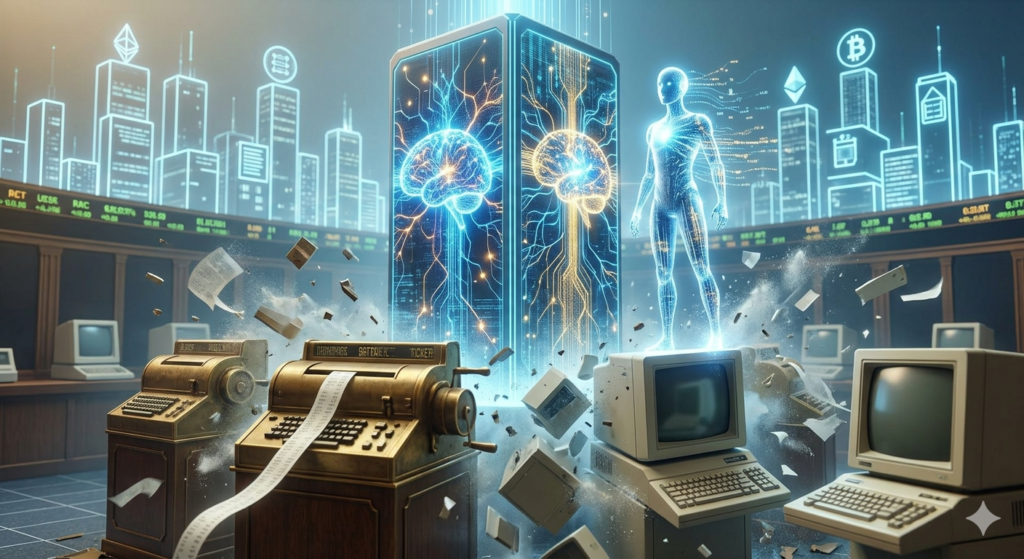
The Great Decoupling: Productivity vs. Labor
The global economy has officially crossed the “Intelligence Rubicon.” As of Q2 2026, we are no longer speculating about the impact of artificial intelligence; we are living in its fallout. While early predictions focused on the threat of mass unemployment, the reality of the 2026 Semantic Economy is far more nuanced: a massive surge in industrial productivity is colliding with a fundamental redefinition of how wealth is captured and distributed.
The Great Decoupling: Productivity vs. Labor
For the first time since the Industrial Revolution, the historical link between human labor hours and GDP growth is severing. According to recent 2026 fiscal data, industries with high AI exposure specifically software engineering, legal services, and financial analysis have seen a quadrupling of productivity growth since 2022. However, this surge hasn’t translated into a traditional “hiring boom.”
Instead, we are witnessing the Rise of the Intelligence Bridge. Organizations are no longer scaling by adding headcount; they are scaling by deploying Agentic AI Models that handle the heavy lifting of middle management scheduling, risk assessment, and operational reporting. Gartner reports that through 2026, 20% of organizations have successfully flattened their structures, eliminating over half of traditional middle management roles in favor of AI-human hybrid teams.
From Labor-Capital to Intelligence-Equity
This shift has created what economists call the “2026 Digital Divide.” The winners in this new landscape are not those who work the longest hours, but those who own the “Intelligence Assets.” As the cost of expertise drops toward zero, the value of Algorithmic Wealth Management and Tokenized Private Markets has skyrocketed.
For the modern professional, “Wealth Tech” is no longer an optional tool—it is the primary defensive strategy against the deflation of human labor value. To thrive, one must shift from being a provider of intelligence to a manager of autonomous systems.